

The only thing visible in the meter photo is 8%. Was the board under the meter from the lot waiting to ship? That question has to be settled before the buyer can use the result. The lot number, the board picked for testing, the way the reading was taken and the release limit all belong in the wood flooring moisture content record.
Ask for the inspection sheet when the quotation is issued. If the factory normally sends a meter photo, request a sample record showing the board ID beside the display. The ID should connect the photographed reading to a specific board in the shipment.

Which production stage does the number describe?
An incoming veneer reading describes incoming material and can help the factory monitor it before processing. It does not establish the moisture content of finished flooring. For a pre-shipment report, check the inspection date and production stage so a drying-stage result is not mistaken for a finished-lot reading.
A request to YEHUI can identify the production location: Huzhou in Zhejiang or Jinan in Shandong. The report should name the stage represented by each reading rather than treating a result from one stage as the finished-product result.
Keep incoming, in-process and finished readings separate
YEHUI’s production work includes fine sanding, surface treatment and lacquer finishing, with machine-assisted and manual inspection of dimensions, thickness, moisture content and stability. Pieces are inspected and screened before packing.
When a report includes several checks for one lot, label each value and unit. A thickness result in millimetres must remain distinct from a moisture percentage, so follow-up can focus on the questioned measurement without repeating checks already completed.
Match every reading to a product and a lot
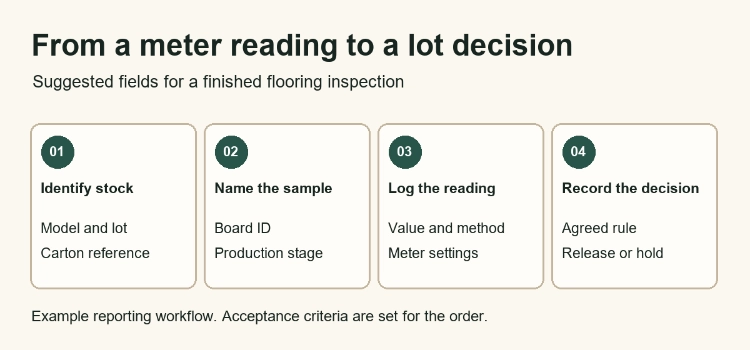
A purchase order number alone may not identify the tested stock when a shipment contains several lots. Give each sampled board a short ID and link it to the product model, lot number and, where useful, a carton or pallet reference.
What to do with similar products in the same shipment
A report showing only “510 × 92 mm” may still leave the model unclear. Several YEHUI models share that nominal size across different wood species, so the model code—not size alone—must identify the sampled product.
| Product model(s) | Wood species / selection | Nominal size / record detail |
| JY8103 Chevron wood flooring | Nogal negro | 510 × 92 mm |
| JY8102 / JY8105 | Nogal negro | 510 × 92 mm |
| JY8110 / JY8111 / JY8113 / JY8115 | roble | 510 × 92 mm |
| Y201 / Y207 | roble | 510 × 92 mm |
| Y6801 / Y6805 | Nogal negro | 510 × 92 mm |
| Y211 / Y212 / Y215 | roble | 530 × 127 mm |
| SC7602-F | Custom-made wood selection | Record the agreed configuration |
The model code must stay on every sample line. Dimensions help flag a specification mismatch, but they cannot distinguish products when several codes share the same format.
En SC7602-F plank sits in YEHUI’s Engineered wood flooring range and uses a custom-made wood selection. For a customized order, record the agreed configuration beside the code. Otherwise, the inspection may be checked against an earlier specification that predates the buyer’s final face selection.

Check the measurement method and test conditions
For layered products, materials beneath the face can affect the reading. Identify the meter and the part of the board tested, then record the instrument settings, test depth and correction settings required for that construction. The NWFA technical guidance on moisture meters discusses these factors; the test sheet should show the actual settings used so the result can be checked against the procedure agreed for the order.
Record the method and conditions with each result
A worksheet may show a meter reading and a separate reference result from a specimen. If a reference test uses drying and weighing, label it as such: the USDA Wood Handbook chapter on moisture relations describes wood moisture content in relation to water mass and oven-dry wood mass. If the second test was requested because the meter reading was questioned, record the reason beside both results.
Record the carton opening time, test date and location, plus temperature and relative humidity when the agreed procedure requires them. A board left out of its carton can exchange moisture with the surrounding air, so the time between opening and measurement matters when a receiving team repeats the check after transit.
Look at the spread before signing off
An average can conceal an individual result that needs review. The two illustrative sample sets below both have a mean of 8%, but their individual readings differ.
| Set | Individual readings | Spread |
| A | 7%, 8%, 8%, 9% | 2 percentage points |
| B | 6%, 7%, 9%, 10% | 4 percentage points |
Both sets have an average moisture content of 8%, but Set B has a wider spread and an individual reading of 10%. If the agreed purchase specification sets a lower individual maximum, that board should be held for review. Buyers should assess the overall distribution and individual readings rather than relying on the average alone. These figures are illustrative and do not represent a universal flooring standard.
Agree the sample count and selection method before cartons are opened. If samples come from mixed pallets, specify whether pieces should be selected across cartons or lots. Record how each board was selected so the inspection can be repeated.
If a reading is challenged, record the recheck beside the original, including what changed, such as a corrected meter setting. Keep lot totals separate. If only part of a shipment is released, identify the cleared stock and the stock still on hold.
Put the release decision in writing
Define the acceptance and hold criteria
Put the release rule in the purchase documents before sampling. Leave space for a decision on each lot. If a lot is held, the sheet should state what information is missing, who must respond and where the affected cartons are. This allows a recheck to be arranged while the loading list is still open.
Handle exceptions and rechecks
When a report contains a carton code that does not appear on the shipping list, ask how the two records are linked. Keep the affected stock on hold while the buyer checks whether cartons were repacked or the code was entered incorrectly.
Keep the signed report with receiving records
Save the signed sheet for receiving. If a result looks different after transit, start with the original board and lot references. Review where the meter was applied and how long the samples were out of their cartons; the factory can compare those details with its own records while the stock is still identifiable.
For customized orders, YEHUI provides product consultation, design, measurement and sampling support, taking the buyer’s budget, style, dimensions and requirements into account. The company also provides sales and after-sales support and works with building materials dealers. Buyers can submit the chosen specification and inspection fields together to clarify which checks can be completed for the order.




 Spanish
 English
 Arabic
 French
 German