

A distributor can agree to a number of cartons without yet knowing how much flooring that represents. The panel model alone does not answer it. Before calculating square metres per carton, purchasing needs the supplier to confirm the net area of a panel and how many complete panels are packed. Multiply those two values.
For distributors, a parquet flooring calculator is useful once that information is available. Until then, its result is an estimate. The enquiry should establish the supplier’s quantity basis before the purchasing team enters that estimate as confirmed stock.
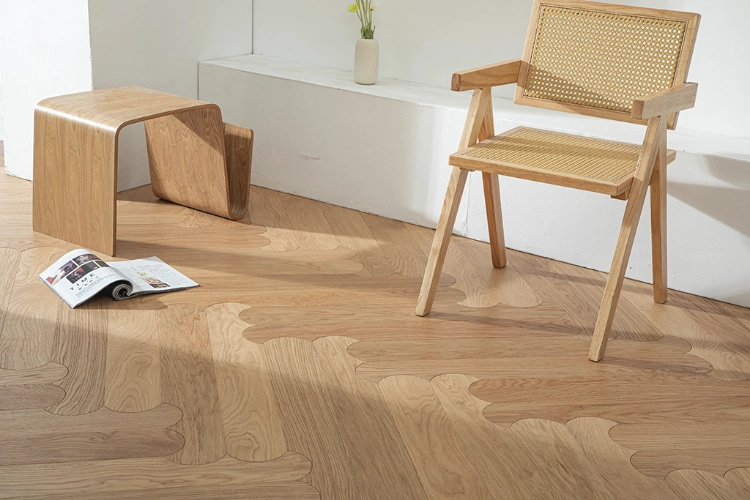
Identify the panel before calculating its area
A screen image is a poor ruler. Two square panels can occupy the same space on a product page despite having different physical dimensions. The calculation needs the size attached to the selected model code.
YEHUI offers three oak square-parquet models: PH-003 (395 × 395 mm), PH-001 (450 × 450 mm), and PH-009 (500 × 500 mm). Its mixed-wood options include PH-002, which combines black walnut and rosewood in a 450 mm square panel, and PH-012, which combines black walnut and maple in a 500 mm square panel. Confirm the selected model’s net panel dimensions before calculating carton coverage; the panel size alone does not establish how many panels are packed per carton.
The model code, wood combination and stated dimensions identify the selected product. They do not establish how many complete panels are packed or what net coverage the supplier declares. Confirm those details separately.
A visible pattern is not automatically the counted unit
PH-001 shows a square border surrounding a centre divided by diagonal lines. Several lines meet near the centre of the photographed panel. PH-012 shows a broad brown central field, narrow perimeter bands and a pale decorative motif near one corner.
The word “piece” needs care here. In a design discussion it might mean a decorative section inside the square; on a purchase order it might mean the complete panel. Put a description of the item being counted beside the reference image and ask the supplier to confirm it. That resolves a quantity question which the pattern photograph alone cannot answer.
Obtain the net coverage figure for the selected product
Either a confirmed area per panel or a confirmed pair of net dimensions will allow the calculation to proceed. For dimensions, ask where the measurement starts and ends. The answer matters if the quoted size includes a projection or another edge feature. “Nominal size” does not resolve that question.
An assumed joint allowance would introduce another unknown. Subtracting it from the printed size may produce a precise-looking answer, but there is still no agreed basis for using that answer. Leave the coverage field unconfirmed until the supplier explains the measurement.
YEHUI’s production process includes cutting, sizing, drying and moisture control, followed by fine sanding, surface treatment and lacquer finishing. Machine-assisted and manual inspections check dimensions, thickness, moisture content and stability, with individual pieces screened before packing.
These production checks support product quality, but they do not establish carton coverage. Record the confirmed net area and packing count against the quoted model so the calculation can be checked again when the order is reviewed.
Calculate panel, carton and order area separately
Convert both dimensions to metres
For a square panel whose confirmed net side is s metres, panel area is s × s. Carton area is that result multiplied by the confirmed panel count. The distinction between length in metres and area in square metres is set out in the NIST SI units guidance. Both units belong on the worksheet, beside the quantities they describe.
The worked example uses four complete panels per carton and a hypothetical net face of dimension 450 mm × 450 mm. These inputs are illustrative only and do not describe YEHUI’s packing. The table follows the calculation from one panel to one carton and then to 17 cartons.
| Calculation level | Hypothetical calculation | Result |
|---|---|---|
| One complete panel | 0.45 m × 0.45 m | 0.2025 m² |
| One carton | 4 panels × 0.2025 m² | 0.81 m² |
| Seventeen cartons | 17 × 0.81 m² | 13.77 m² |
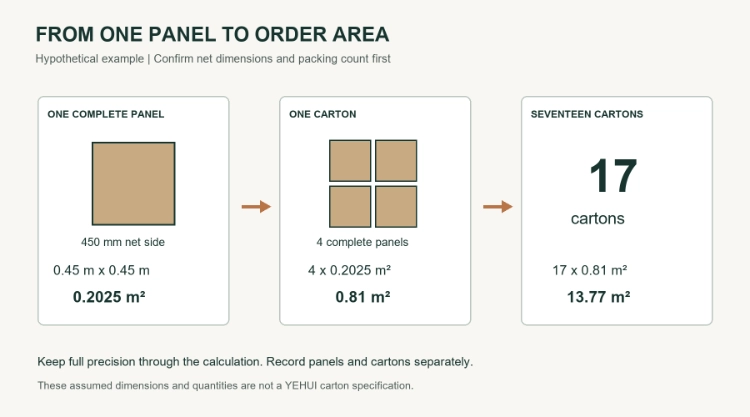
Label the 0.81 figure as square metres per carton and keep the panel count beside it. That makes the calculation basis visible and allows another person to check the multiplication.
Alternatively, the worksheet can leave the side lengths in millimetres: 450 × 450 = 202,500 mm². The next operation is division by 1,000,000, giving 0.2025 m². Both length dimensions are being converted, so dividing by just 1,000 is insufficient. Either calculation route is valid if the units remain visible beside the values.
Keep unrounded values until the final total
Rounding each carton to 0.8 m² instead of retaining 0.81 m² changes a 17-carton total from 13.77 m² to 13.6 m², a difference of 0.17 m². The discrepancy comes from rounding the input, not from a change in panel count.
If the worksheet and carton declaration differ, first check which unrounded figure was used. If the totals still do not reconcile, verify the confirmed panel coverage and packing count, then retain the explanation with the receiving record.
Keep separate products on separate stock lines
YEHUI’s black-walnut PH-006 option has stated dimensions of 580 mm by 580 mm. PH-007 also uses black walnut, in a stated 450 mm by 450 mm format. The teak parquet options PH-015 and PH-016 both have stated dimensions of 600 mm by 600 mm.
Shared wood names or matching dimensions do not make these products one stock item. Keep the selected model and specification on a separate line with its confirmed coverage and carton count; add the order areas only after each line has been calculated independently.
| RFQ field | What the supplier’s response should identify |
|---|---|
| Model and specification | The exact product covered by this quantity line |
| Counted item | A complete supplied panel or another explicitly defined unit |
| Net area basis | Confirmed area per panel, or the net dimensions used |
| Packing count | Number of counted items in each carton |
| Declared carton coverage | Area calculated on that same basis |
| Order total | Number of cartons and resulting square metres |
When the panel format or packing changes, update the stock line rather than carrying forward an old coverage figure. Recalculate each model using its current net area and carton count.
For part-carton orders, calculate loose complete panels from their actual count and add that area to the full-carton total. Keep damaged or incomplete panels outside the complete-panel count until their receiving status is decided.
Reconcile the requested area with whole cartons
Using the same hypothetical coverage of 0.81 m² per carton, a 50 m² request requires 50 ÷ 0.81 ≈ 61.728 cartons. If only whole cartons can be ordered, purchasing would request 62, representing 50.22 m². This is the coverage purchased, not an allowance for spare stock or cutting waste.
Any spare-stock or cutting allowance should be calculated separately. If some material is held for inspection, record its status separately rather than changing the coverage multiplier.
Send a quantity question with the product reference
YEHUI offers consultation on its products, alongside design work, measurement and sampling services. Budget, style and dimensions are among the requirements considered in its customization work. For an enquiry about LZY03 parquet flooring, ask for the coverage and packing information for that exact model. Do not transfer a PH-series quantity record to LZY03 unless the product and packing specifications have been confirmed as equivalent.
El más amplio parquet project specification guide covers the surrounding product decisions. For the quantity calculation, the supplier’s reply needs to confirm the counted unit, net area basis and packing count for the selected model. Those inputs give purchasing a figure it can verify against the order.


 Spanish
 English
 Arabic
 French
 German