

A repeat order can have the right colour, width and overall thickness and still leave an unanswered question at the joint. For a distributor buying replacement stock or a project supplier adding to an earlier order, “tongue and groove” is too little information to settle compatibility. The useful comparison is between the old and proposed profiles, measured from the same face and checked separately along the sides and ends.
That check belongs before order release. A sample that looks familiar across a desk is not enough evidence for stock that must meet an existing product. The buyer needs a named reference piece, an identifiable proposed product and a written account of the differences that remain.
Start with the exact product, not the thickness
The first request should identify the earlier order number, product code, pattern and approved specification. If those records are incomplete, photographs of packaging and retained pieces can help the supplier identify the product. A guess based on colour should stay a guess until someone resolves it.
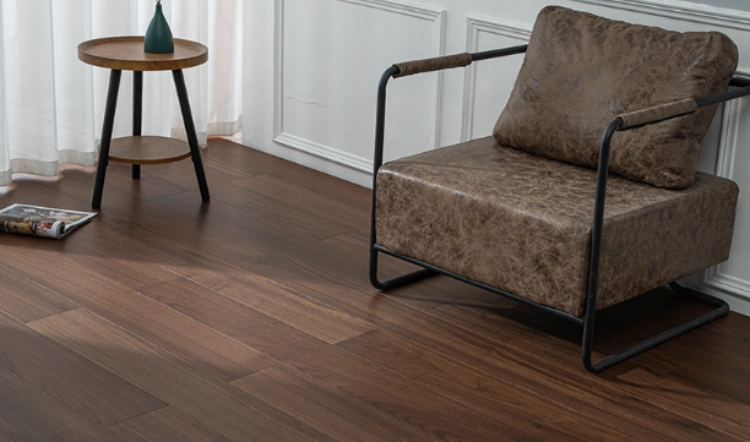
Within YEHUI‘s Engineer wood flooring selection, QH1903 and QH1906 are oak options, while QH1923 and QH1925 use black walnut. These QH planks have a listed length of 1,210 mm and a width of 165 mm. The listed QH1925 dimensions provide an initial reference for the inquiry. Before approving a repeat order, buyers should also request the current joint-profile drawing, specification revision and applicable dimensional tolerances for the proposed product. The record should distinguish the original product from an offered substitute, including a substitute suggested because the old product is unavailable. Substitution is a separate approval decision, not a clerical change to the order.
Similar dimensions can hide different products
YEHUI’s Herringbone selection includes oak models JR9110 and JR9111 listed at 600 mm long and 92 mm wide. JR9102 and JR9103 are black-walnut Herringbone options with the same listed length and width. These are distinct product identities, despite their matching nominal dimensions.
The distinction also matters within Chevron wood flooring. Oak options Y201 and Y207 are listed at 510 mm by 92 mm. Black-walnut options Y6801 and Y6805 have those listed dimensions too. Neither pair of numbers establishes that two products have interchangeable joints.
The quotation may settle the product identity while leaving fit completely unanswered. A purchasing team needs to spot that gap. The response should connect the proposed product to the retained reference and explain the comparison made, rather than repeat the same nominal dimensions already printed on the order.
Compare the profile from one reference face
For a section drawing, the buyer and supplier should agree which face is the reference. A tongue position measured from the upper face cannot be compared directly with a groove position measured from the underside. Both figures may be accurate while the comparison is wrong.
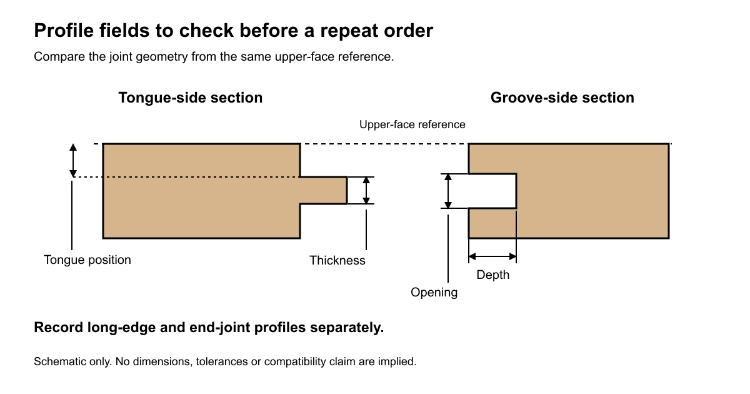
Illustrative profile checks. The drawing is not a YEHUI product specification and gives no acceptance tolerances.
Only then do the dimensions become useful. The supplier’s response should identify the limits applicable to the proposed product. Copying a tolerance from an unrelated specification would give the order an impressive-looking number without establishing whether either party can use it.
| Profile item | What the comparison must identify |
| Overall thickness | The same measurement location on both pieces |
| Tongue thickness and position | Thickness plus its position from the agreed reference face |
| Groove opening and position | Opening size and location, using that same reference |
| Tongue projection and groove depth | Available engagement and whether either feature reaches its limit |
| Shoulders and reliefs | The surfaces intended to meet and any spaces intentionally left clear |
Numbers without a section sketch are easy to misread. The supplier can mark the measurement locations on a drawing or a clear annotated image. That modest addition often answers more than another row headed “T&G: yes.”
Consider a hypothetical comparison in which the old and proposed boards share an overall thickness. The proposed tongue sits closer to the top face, while the old groove remains lower in its section. A purchasing spreadsheet containing only overall thickness would miss that difference. A section comparison would expose it immediately, without assuming any particular acceptable clearance. This example explains why the reference face matters; it does not specify a YEHUI profile.
Give the long edge and the end their own records
One side-profile photograph should not stand in for all four edges. The end joint needs its own identification and comparison. For a patterned product, the request should also show which pieces are intended to meet. This avoids treating a photograph of one edge as proof of every possible connection.
Check the sample without turning a trial into a guarantee
YEHUI’s manufacturing steps include wood cutting, drying and moisture control, followed by fine sanding, sizing, surface treatment and lacquer finishing. The company combines machine checks with manual inspection. Those checks cover dimensions, thickness, moisture content and stability. Material selection and screening before packing also form part of its process.
These controls are relevant to a dimensional inquiry. A buyer should still request evidence for the actual proposed repeat order rather than assume that a general description of quality control settles compatibility with an older product.
A loose sample needs enough labelling to survive the next round of correspondence. Product code, specification revision and supplier response should point to that piece. Suppose another sample arrives a week later with a revised profile: the buyer must be able to tell which one was reviewed and which one now accompanies the offer. Any accepted difference belongs in that record.
Keep measurement conditions visible
The measurement date, instrument identification and units belong beside the readings. So do relevant storage or moisture conditions. If the old reference and the proposed sample were measured under different conditions, the supplier should explain what that means for the comparison. Combining the readings in one table does not make the conditions equivalent.
NIST measurement guidance treats calibration, variability and uncertainty as separate parts of a measurement process. For this buying decision, the practical point is to retain the method with the numbers. That guidance does not supply a flooring acceptance limit.
Put the comparison into the repeat-order request
YEHUI offers product consultation together with design, measurement and sampling support. Its customization work takes account of the buyer’s budget, preferred style, dimensions and other requirements. The company also works with building-material dealers and has sales and after-sales support.
The inquiry can use those services to resolve a specific question: what must be checked before the proposed product is approved against the reference? It should attach the reference identification and request a response against each unresolved profile item. The buyer should avoid treating the availability of sampling as a promise that a particular old and new product will match.
The design-led range focuses on Herringbone, Chevron wood flooring and other parquet patterns. Consequently, the request should name the pattern as well as the model. A general request for an additional quantity of wood flooring leaves too much room for a technically different offer.
Decide what can be released and what needs an answer
A short decision record should finish the check. It can state the reference identity, proposed product, measurements reviewed, sample identification and any accepted differences. The purchasing and technical contacts should be able to find the same record without reconstructing the decision from several email chains.
Approval should also say what was examined. Reviewing a drawing, comparing loose reference pieces and accepting an order specification are different actions. A record that identifies the action and its limits is more useful than a signature beside an unexplained “approved” stamp.
An unresolved difference belongs on hold. A reply such as “the new stock uses the latest specification” still leaves the old reference unaddressed. The buyer needs an answer to that particular comparison. Where compatibility cannot be confirmed, a separate allocation or another agreed supply arrangement can be considered before release. That is a commercial decision for the order team, with the technical limitation left visible in the record.
Frequently Asked Questions
Can tongue and groove flooring with the same thickness be used interchangeably?
No. The same overall thickness does not guarantee a matching joint. Buyers should compare tongue thickness, groove opening, position and depth using the same reference face.
What information should I provide when placing a repeat flooring order?
Provide the previous order number, product code, pattern and approved specifications. If the records are incomplete, retained samples and packaging photos can help identify the original product.
Should I check both the long edge and end joint before approving a sample?
Yes. The long-edge profile and end-joint profile should be checked separately. A sample that matches on one edge does not automatically confirm compatibility on all sides.




 English
 Spanish
 Arabic
 French
 German