

A custom parquet flooring drawing needs to show which way the motif faces. A product code alone cannot communicate that decision. The outline may still look familiar after a quarter turn, yet a particular dark band now meets a different side of the drawing. That is enough to change what the designer and purchasing team are looking at.
An importer passing a revised drawing to the manufacturer should establish what the edit means. Has the complete motif turned? Has one part moved while the rest stays put? Or has someone simply rotated the picture for a presentation? The drawing should answer that before it becomes an order reference.
YEHUI focuses its design-led range on Herringbone, Chevron wood flooring and other parquet patterns. Its shaped-flooring selection includes curved outlines, diagonal bands and star-like arrangements. Those different visual structures give a purchasing team concrete features to identify when discussing direction.
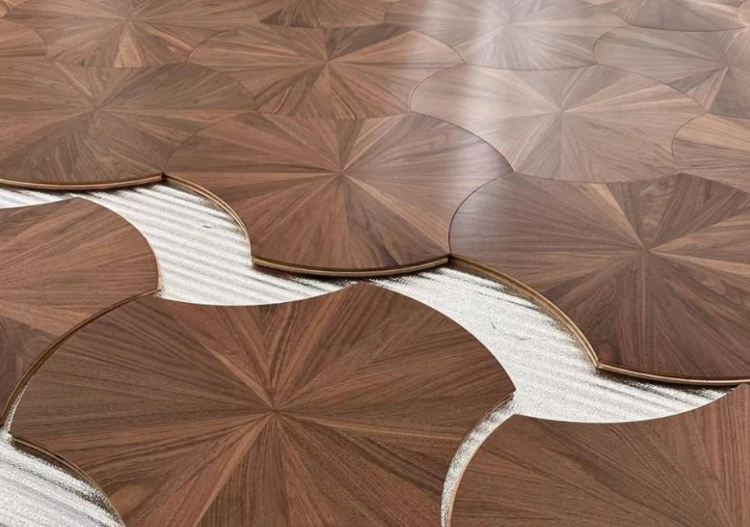
What a rotation mark needs to communicate
An arrow is easier to use when it is attached to a specific instruction. The starting view must be identifiable, and the note needs a centre of rotation together with the angle and direction. There is still one more detail to settle: whether the note applies to the whole motif. An arrow beside a single coloured section can otherwise suggest a much smaller edit.
“Turn clockwise” is incomplete when one reviewer is looking at an upright screen and another has rotated a printed sheet. The instruction needs a stable reference within the drawing. A marked corner, an identified centre and a reference arrow can provide that reference without making the drawing crowded.
Rotation and reflection are different edits
Turning a shape around a point is rotation. Creating a mirror image across a line is reflection, a different operation covered in the National Centre for Excellence in the Teaching of Mathematics’ guidance on transforming shapes. A rotation description needs the centre, angle and direction of the turn.
A flip command is worth checking in the revision history. It can produce an attractive reflected design without performing the requested rotation. If that reflected version is intentional, it needs its own proposal label so the manufacturer can distinguish it from the original design shown at another angle.
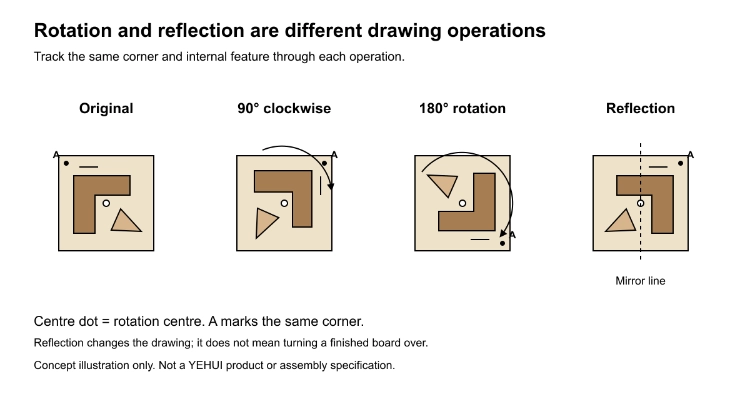
Concept illustration: rotation and reflection change the drawing in different ways. Not a YEHUI product or assembly specification.
Read the direction inside the motif
The review should follow a feature inside the drawing as well as its outer boundary. A dark strip or a visible grain line is often easier to track than a repeated outline. That gives both readers something specific to locate in the revised view.
Curves and diagonal bands
YEHUI’s YX-002 image shows broad, curved outlines meeting around an irregular central shape. The grain runs in visibly different directions across neighbouring areas, and the pale curved lines remain visible against the brown surface. The photographed design contains both rounded edges and pointed junctions.
For a proposal based on that appearance, an arrow pointing vaguely at the curve leaves too much open. The designer should identify the particular tip or junction intended to face the reference direction. That mark follows the chosen feature when the illustration turns.
YX-003 presents a different problem. Its image shows alternating light and dark diagonal bands with staggered, angular ends. The bands appear to cross through the arrangement, while the contrasting tones make their sloping direction visible across the picture.
A rotation proposal should move that colour arrangement together with the motif unless the designer specifically requests a different arrangement. Rotating the outline while leaving the internal artwork untouched creates another design proposal. It deserves its own illustration.
Hexagons and star-like repeats
YX-010 shows adjoining hexagonal shapes in several tones, including blue, grey, pale cream and warm brown. The outline repeats across the image, but the colours occupy different positions. Some hexagons show visible grain while others read as more even areas of colour.
The drawing reviewer can track a named coloured area through a proposed turn. This avoids relying solely on the repeated hexagonal outline. The photo is a design reference, not a precise colour standard for an order.
YX-017 shows a repeated star-like arrangement built from angular sections in lighter and darker brown tones. Several sections meet at visible centres, and their contrasting grain directions contribute to the radial appearance. The pattern continues beyond one central star into neighbouring repeats.
YEHUI’s YX-001 image also has a radial appearance, with fan-like groups of grain spreading from several centres. Curved boundaries divide those groups, giving the photographed surface a different structure from the angular star-like shapes of YX-017.
For either radial design, an apparently similar outline does not settle the orientation of every visible feature. The reviewer should track one identifiable section through the proposed change. No exact symmetry or permissible turning angle should be assumed from the photograph.
Give the drawing a reference that survives a rotated screen
A simple drawing convention can keep the discussion focused. The proposed reference view can be labelled “finished face viewed from above”, with one arrow identifying the top of that view. A separate rotation arrow then describes the requested change relative to it.
The two arrows have different jobs. The reference arrow stays tied to the original drawing. The rotation arrow communicates an edit. Labelling them prevents the designer’s intended turn from being confused with a page-orientation symbol.
Consider an illustrative instruction for an asymmetric motif: “View B: rotate the complete motif 90° clockwise about point C from View A; retain the internal colour arrangement.” Before approving this rotation, confirm that the manufacturer can reproduce the proposed orientation while preserving the specified internal colour arrangement and component geometry.
The example is useful because it names the starting view and the scope of the edit. If only one coloured section is meant to move, that sentence is wrong. A revised sketch should show the affected section explicitly, with the remaining artwork held in its reference position.
The design team should also distinguish a changed design from a differently presented image. Rotating a photograph for a presentation does not necessarily request any change to the product. A short label such as “view rotated for presentation only” can resolve that ambiguity before purchasing interprets the image as a new requirement.
A pattern sketch does not define the delivered components
The YX shaped-flooring examples have custom-made specifications and list UV technology. Those descriptions do not identify which visible outline represents a delivered component, or show the joint beneath its face. A photograph cannot establish those details either.
This matters for a rotation request. A designer may be turning a visual motif on screen; the supplier still needs to confirm how the requested appearance relates to the product proposed for supply. The buyer should not infer that every photographed section is a loose, independently turnable piece.
Chinese knot parquet y LZY23 parquet should be identified by their respective product specifications during design approval. Similar visual elements do not establish identical construction, dimensions or installation requirements. Confirm the selected product code and manufacturing drawing before approving any pattern rotation or substitution.
Turn the design question into a focused YEHUI enquiry
YEHUI provides product consultation together with design, measurement and sampling support. Its customization service considers the buyer’s budget, style, dimensions and requirements. These services give a design coordinator a way to discuss a specific visual proposal rather than relying on a short pattern name.
The enquiry can contain the chosen product reference and two labelled views: the starting appearance and the proposed rotation. Any reflection should be shown separately. The buyer can then ask which part of the proposal is feasible and what further product information is needed.
The immediate decision is whether both parties are discussing the same visual change. A clear reference and a correctly labelled turn make that decision possible before the purchasing team treats the design as settled.




 Spanish
 English
 Arabic
 French
 German