

An Australian importer comparing an herringbone flooring supplier Australia can trust should start with the specification, not the photograph. Two samples may look close on a screen while differing in construction, pairing, joint profile, moisture control and finish. A good specification turns those differences into checks before production.
YEHUI produces Multi-Layer Engineered Wood Flooring, herringbone flooring and other artistic parquet formats from manufacturing bases in Huzhou and Jinan. For an Australian flooring program, the useful question is not simply whether a pattern looks European. It is whether the supplier can hold the same construction, dimensions, surface and packing reference from sample approval to repeat shipment.
Which Construction Details Should an Australian Buyer Lock?
The construction section should explain how the floor is built and how the configuration supports the range. It should be specific enough for the buyer and factory to read the same way.
Multi-Layer Engineered Construction and Stability
Multi-Layer Engineered Wood Flooring uses layers arranged in different directions to manage movement through the board. That logic is useful when an Australian importer needs a product that can move between different interior programs without relying on a solid timber description alone. It does not remove the need for correct storage and project conditions, but it gives the specification a clearer structural basis.
Write the construction as a defined layer system, then state the core material, total thickness and face layer. A supplier should connect the visible top layer to the production construction used for the order.
Total Thickness and Custom Wear Layer
The face layer can be customized to 3 mm, 4 mm or 6 mm. The buyer should select the value according to the collection position, expected use and future maintenance plan, then keep it identical across the quotation, sample and purchase order. If several thicknesses are offered, they need separate model codes and sample references.
Thickness also affects how a pattern sits with adjacent materials. A change that seems small in a catalogue can create a different junction at a doorway or border. The engineered herringbone flooring specification should therefore record total thickness and face layer together rather than treating them as separate sales details. This herringbone flooring supplier Australia check also protects the transition drawing.
Left-Right Pieces, Joint Profile and Pattern Pairing
Herringbone is assembled from paired pieces, so the buyer should approve how left and right elements are identified and packed. Confirm the joint profile, the direction of the tongue and groove or click connection, and the way pieces are mixed in a carton. One attractive board cannot show whether the pair produces a clean repeated line.
This is especially important when a retailer sells a layout as a complete system. A naming rule for left and right pieces prevents confusion during stock handling, while an approved assembly panel shows whether the joint and angle remain consistent. A practical herringbone flooring supplier Australia program begins with this pairing decision.
How Should Dimensions and Layout Be Written Into the Specification?
Patterned flooring is sensitive to small errors because each piece meets another at an angle. The dimensional section should describe both the board and the finished layout.
Board Length and Width for the Intended Room Scale
Choose board proportions based on the intended room scale and sales range. Longer pieces can create a calmer directional rhythm, while shorter pieces create more frequent turns and may suit smaller design zones. The choice should be shown on a full layout drawing, not inferred from a single board.
For Australian orders, record length, width and total thickness together. Add piece count or pairing when cartons use left-right sets. This makes a wholesale herringbone flooring specification easier to compare and helps a herringbone flooring supplier Australia quote consistently.
Pattern Direction, Starting Line and Border Treatment
The layout drawing should show the starting line, the main direction and the treatment at walls, doorways and borders. A 45-degree arrangement and a 90-degree arrangement can produce very different visual movement even with the same pieces. Buyers can compare herringbone layout types and starting directions before they approve a sample for the Australian market.
Ask for a drawing with one complete repeat and the intended border. It should show whether the pattern is supplied loose or as preassembled modules, since that affects packing and downstream layout work.
Dimensional Tolerance and Pre-Shipment Checks
Dimensions and thickness should be checked before shipment, together with moisture content and stability. YEHUI uses machine and manual checks for these areas. Buyers still need to agree on the sampling method, records and action when a result falls outside the approved range.
Do not leave tolerance as a general promise. Define which dimensions matter most for the assembled pattern, how a lot is identified and who signs the release record. Quality control should connect to the buyer’s actual layout.
| Specification field | Buyer decision | Release check |
| Construction | Layer system, total thickness, face layer | Matches approved sample |
| Piece pairing | Left-right identification and joint profile | Carton contains the correct pair |
| Layout | Starting line, direction, border and repeat | Full panel follows the drawing |
| Surface | Sheen, texture and accepted tone range | Physical finish sample retained |
| Moisture and stability | Inspection method and acceptance range | Lot record is complete |
| Packaging | Labels, protection and replacement reference | Stock stays traceable |
Which Surface and Batch Controls Matter for Import Orders?
A surface sample is part of the product specification because sheen and texture affect how the pattern is read in a room. Batch controls then keep that reference useful after the first shipment.
Finish Sample and Gloss Reference
Approve the finish under neutral light and record the reference beside the construction and pattern code. Screen images are useful for discussion but should not be the final gloss reference. Natural wood variation also needs a written accepted range, so the buyer is not asking the factory to reproduce a printed color exactly.
Include edge treatment, texture direction and ordinary natural variation. When the buyer, warehouse and installer use the same physical sample, a herringbone flooring quality check becomes easier to explain. This check should appear in the inspection brief as well.
UV-Cured Surface Characteristics
UV coating can cure under high-intensity UV light in seconds to tens of seconds. The process supports a controlled finishing line, and the cured layer is discussed in terms of hardness, wear resistance and adhesion. These are useful process characteristics, but they should not be turned into an unsupported service-life promise.
The purchase specification should still identify the finish system, sheen and inspection point. If the surface is adjusted, request a new sample or a signed deviation. A fast process does not make an unapproved finish acceptable.
Lot Identification, Carton Labels and Replacement Stock
Record the model, finish reference, production lot and carton contents on the label. Paired pieces should remain identifiable after cartons are separated. Keep the sample code and layout direction with replacement-stock information.
This matters when a project is released in stages. A later carton with only a similar product name may create a visible mismatch. The label should identify the original construction, surface and pairing, so replacement stock remains tied to the approved order.
How Can Three Herringbone Products Serve Different Assortments?
An importer does not need every visual direction in one launch. The better approach is to give each model a clear role in the range and connect that role to a customer or project condition.
ClickLock Herringbone Flooring for Installation-System Buyers
Herringbone Flooring with ClickLock Installation suits a program in which the connection system is part of the buying discussion. Buyers should confirm the exact joint profile, piece pairing, layout method and carton arrangement instead of treating “ClickLock” as a complete installation specification.
Use this model when distributors need a clear system story. Keep the drawing and sample panel beside the product description so the sales team can explain the approved pattern.
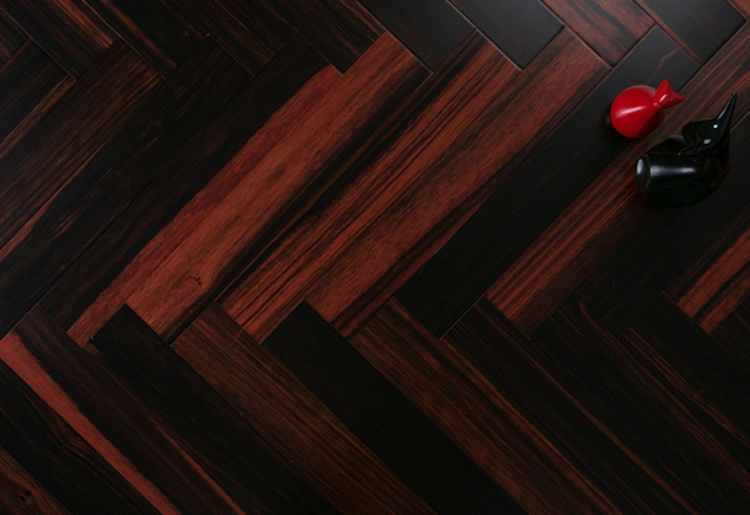
Ebony Herringbone Flooring for Darker Design Programs
Ebony Herringbone Flooring can anchor a darker design program. Dark surfaces often make dust, edge variation and pattern drift easier to notice, so the finish sample and full-panel inspection deserve extra attention. The buyer should define the accepted tone range without promising that every natural piece will look identical.
This type can work as a statement option beside a quieter core model when the catalogue explains its visual scale, finish reference and project position.
Reclaimed Wood Texture Herringbone Flooring for Textured Collections
Reclaimed Wood Texture Herringbone Flooring adds a tactile, aged-looking direction to a textured collection. The buyer should approve how texture, surface variation and pattern pairing appear on an assembled panel. The key check is whether the visual character remains controlled enough for repeat supply.
Keep the model separate from smoother designs. Clear naming, lot labels and a retained finish sample help retailers explain why similar layouts can deliver different visual experiences.
An Australian program should move in this order: construction, dimensions, pairing, layout, finish, inspection and carton identification. A reliable herringbone flooring supplier Australia can connect the approved sample, specification and shipment reference.
Contact YEHUI About an Australian Herringbone Program
Share the Target Construction and Order Volume
Send the intended construction, face layer, target models, estimated quantity, destination and delivery window. Include whether the range is for stock, a named project or both.
Request a Paired Sample and Layout Drawing
Ask for left and right pieces, a full assembly panel and a drawing showing the starting line, repeat and border. Confirm finish, carton identification and the inspection record at the same time.
Confirm the Project Through the YEHUI Contact Page
Project buyers can send the brief through the YEHUI contact page. Keeping the product code, sample reference and layout drawing together gives the technical discussion a usable starting point.
FAQ
What Should an Australian Herringbone Flooring Specification Include?
An herringbone flooring supplier Australia specification should include the engineered construction, total thickness, face layer, board dimensions, left-right pairing, joint profile, layout direction, border treatment, finish reference, moisture and stability checks, carton labels and replacement-stock reference.
Should Buyers Approve Both Left and Right Herringbone Pieces?
Yes. Herringbone depends on paired pieces, so buyers should approve both sides and inspect them in a full assembly panel. This confirms that the joint, angle, direction and repeat work together rather than judging one loose board.
How Can a Herringbone Flooring Supplier Australia Reduce Batch Confusion?
Use one product code, physical sample reference, finish code, layout drawing and carton identification system from approval through shipment. Record the lot and keep replacement-stock information linked to the same specification. This gives a herringbone flooring supplier Australia a clear reference for repeat orders.

 English
  Spanish
  Arabic
  French
  German