

A quote headed “scratch resistant” is not ready for comparison until you can match it to a test. Put the quoted code and finish beside the method and reported result. If the supplier cannot make that link, record the claim as unverified rather than scoring it against other offers.
A photograph, lab report and warranty may arrive in one email, but you should review them separately. First match the report’s specimen to the finish on the quote. The photograph is for appearance; the warranty sets terms; neither proves what the lab tested.
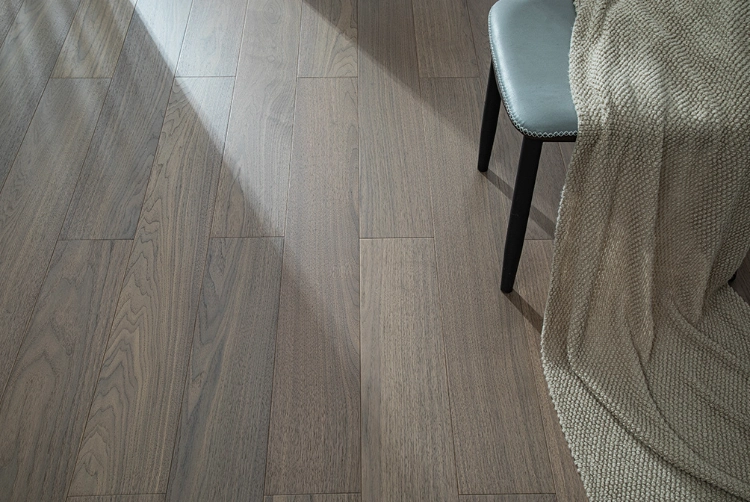
Define what the scratch-resistance statement covers
Separate a general claim from a measured result
A scratch-resistant finish is not immune to marks. Ask for the test method, finish identity and observed result before using that description in a specification. A single clipped result row may omit the test conditions entirely.
Keep a copy of the original sales statement. If catalogue text later adds a number, compare it with the full report and have the supplier confirm it for the finish in this order; do not infer the figure from a collection-level description.
Identify the surface being purchased
The quote should identify species, grade, size, construction, treatment and finish. Oak or walnut, colour variation, matte look, brushing and stain affect the design choice. They should stay in that part of the specification; the scratch claim needs a separate test basis.
Use one controlled brief for the approved colour, size, grade, treatment, border and pattern. If the finish is revised, even for a minor visual effect, send that change with the report back to the supplier for an applicability answer.
Le engineered flooring product range can show which products are available. The buyer still needs evidence tied to the model and finish on the actual quote. A category page is not a performance report for every board shown there.
Ask how the claim was tested
Record the method and the endpoint
Read the result page with the method page open. Look for specimen identity, test conditions and the observation used as the endpoint. A “pass” also needs a source for its limit: the method itself, the project specification or a limit agreed by the parties.
An abrasion result is not interchangeable with an indentation or scratch result. Put them on separate lines even if the cover calls them all “surface performance.” Where the method or endpoint is missing, seek clarification before copying a number into the comparison sheet.
Check the laboratory and the scope
If accredited testing is required, use the NIST laboratory accreditation guidance to understand NVLAP’s certificate and scope, then check the lab’s listing for the relevant method. That status concerns the laboratory’s work. It does not certify YEHUI’s flooring or guarantee a particular result.
Verify the named lab against the relevant activity on its accreditation scope. A logo on the report cover is not a substitute for that check. Keep product and supplier certification claims separate from the laboratory’s accredited status.
Decide whether the evidence applies to the quoted product
Match the model and surface treatment
Lab specimen numbers often differ from commercial product codes. Request YEHUI’s written mapping to the quoted model and finish, and attach it to the purchase file. Similar photographs are useful for discussion but cannot verify which board the laboratory received.
A wood face bonded to cross-oriented base layers describes multilayer engineered wood flooring. That construction detail identifies what is being bought. It cannot, without a surface test, provide a scratch result for the finish.
In YEHUI‘s range, multilayer engineered wood flooring sits alongside Herringbone and Chevron wood flooring. Its stated steps include fine sanding, sizing, surface treatment and lacquer finishing. Specify the finish used on this quote, then ask for its test evidence rather than inferring performance from the production steps.
YEHUI’s machine and manual checks cover size, thickness and moisture content. Those figures may help when goods arrive. Keep the scratch report alongside them but label it separately; it answers a different question about the finished surface.
Keep warranty wording separate from the test result
File the warranty and report together, then note what each covers. One tells the buyer the supplier’s conditions for a remedy; the other records a test on identified specimens. An unmentioned condition in either document should not be assumed from the other.
If the report names a lacquer finish and the quotation names another, the shared collection title does not resolve the mismatch. Leave the scratch wording out of the schedule until the supplier provides a written link or a report for the offered finish.
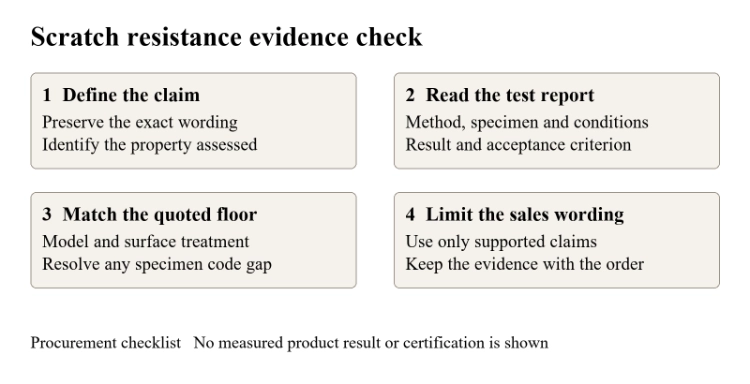
A report supports a purchasing claim only when its scope can be connected to the quoted product.
Compare supplier claims without mixing unlike results
Keep the test conditions in view on the comparison sheet. A lone “pass” hides which specimen, method and limit led to that conclusion. These fields allow an offer to be reviewed without pretending unlike tests share one scale.
| Evidence field | What must remain visible |
| Claimed property | Exact wording used in the offer |
| Tested specimen | Model or code linked to the quoted floor |
| Test basis | Method and reported conditions |
| Outcome | Result and any stated acceptance criterion |
| Document scope | Issuer and applicable product configuration |
Two suppliers may quote numbers from different scratch methods or use different endpoints. The larger number tells little until a technical reviewer checks whether the tests measure comparable outcomes. Mark the comparison open in the meantime.
The purchase file also needs minimum order quantity, sample timing, batch consistency, packaging, lead time and after-sales terms. Evaluate those with the price. Keep the scratch evidence question visible even if a cheaper offer looks attractive.
The order enquiry should also record container loading requirements and request a section drawing of the engineered construction. These fields help purchasing staff identify the proposal without confusing commercial completeness with proof of scratch resistance.
Questions B2B flooring buyers ask about scratch resistance
Does scratch resistant mean scratch proof
No. Use only the wording supported by evidence for the quoted finish and tested conditions. Without an applicable result, the supplier can describe the product’s construction and finish, but should not turn “scratch resistant” into an unlimited performance promise.
Can a report for one finish cover another product
Only if the supplier or issuing laboratory explains how the first specimen covers the second finish. Keep that explanation beside the report and quote; matching collection names, colours or photos do not establish equivalence.
Request a product-specific evidence pack from YEHUI
For a YEHUI product specification enquiry, send the budget, style, size, finish and order details. State the exact scratch question the purchasing team needs answered. Design and sampling support can then be considered alongside the documents available for that configuration.
Request a product sheet naming species, grade, size, construction and treatment for this exact offer, with sample codes and packing terms. Ask for the available test, certification and environmental documents by name. Where one is missing, the final claim should say no more than the remaining evidence supports.

 French
 English
 Spanish
 Arabic
 German