

A purchase order marked “rustic oak” leaves room for an expensive disagreement. The distributor may expect a few small knots; the project buyer may reject pale strips along the boards. Neither expectation becomes an inspection rule simply because both parties approved a colour sample.
For wood flooring grades to work on a purchase order, “acceptable” needs a shared meaning. Which knots may remain, how will an inspector count them, and where may pale sapwood appear? Those details belong beside the selected product code. Retained boards can show the intended appearance, provided the written agreement explains what each board represents.
Start with the exact product and species
An appearance agreement belongs to one identified product. Record its code, face species, colour and pattern before discussing limits. Changing any of these may require another sample review.
YEHUI’s design-led flooring range centres on Herringbone, Chevron wood flooring and other parquet patterns. Its Engineered wood flooring selection also includes oak and black-walnut options. The oak group includes QH1909, QH1906, QH1905, QH1903, QH1902 and QH1901; the black-walnut group includes QH1925, QH1923 and QH1921. These are different product identities, even when a buyer is pursuing a similar overall colour.
For example, an enquiry about the QH1903 flooring option should name that code throughout the approval record. “Same as the oak sample” becomes difficult to interpret after several sample rounds. A different code should trigger a check of the agreed appearance rather than inherit the previous approval automatically.
The broader flooring sample comparison guide can support the overall selection. The knot-and-sapwood sheet has a smaller job: defining which visible features the order may contain.
Give knots their own acceptance fields
Separate size from frequency
An inspector can measure the largest knot and still miss the buyer’s concern. Perhaps no single knot is large, but there are small ones across most of the face. The appearance sheet needs somewhere to record frequency as well as size, or both parties may be applying different tests to the same board.
For an irregular knot, the longest visible dimension is one possible measurement. The supplier should confirm the method before anyone fills in a maximum value. A photograph marked with the actual measuring line removes an ambiguity that the phrase “small knots permitted” leaves untouched.
The count also needs a unit. Per board and per metre are not interchangeable when board lengths differ. If the parties choose a board-based limit, the record should identify the board size to which it applies. Any special treatment of clustered knots needs its own note. These are fields to negotiate, not universal limits that can be copied from another manufacturer’s grade table.
YEHUI’s QH plank options are listed at 1,210 mm long and 165 mm wide. Its R-series oak Herringbone options are 450 mm long and 75 mm wide. The R8821 and R8825 Herringbone options have those same listed dimensions but use black walnut. The oak Chevron wood flooring options Y211, Y212 and Y215 are 530 mm long and 127 mm wide. A per-board allowance needs to identify which format is being assessed; an appearance rule should not follow a loose species label across different products.
Record filler and edge position
Approval of knots should include their finished appearance. A dark filled area can stand out against a pale finish even when the knot itself falls within the agreed size limit. Photographs and physical references should show the permitted filler colour and the finished surface condition.
Features close to a board edge deserve a separate decision. A centrally located feature and one intersecting the edge may have different visual effects. Buyers should ask whether both are included in the proposed grade, then record any exclusions. An appearance acceptance must not be used to waive a separate requirement for a sound, properly manufactured board.
Describe sapwood by area and location
Sapwood can create a visible colour contrast. White oak, for example, can combine cream-coloured sapwood with light-brown heartwood, as shown in the NWFA’s white oak species guide. This example explains the appearance issue; it does not identify the exact oak species in a particular YEHUI order.
“Some sapwood allowed” still leaves two questions open: how much, and where? A thin strip beside an edge may be acceptable to a buyer who would reject a broad pale area across the centre. The approval should address both coverage and placement.
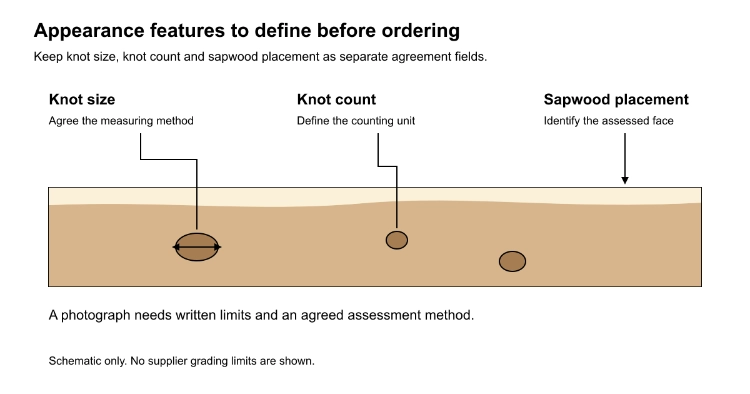
Illustrative appearance record. The marked features are fields for agreement, not YEHUI grade limits.
An area allowance needs a defined surface: the visible face, for example. It also needs a way to estimate the pale portion. The important distinction is whether the limit applies to one board or to a shipment. Several clear boards cannot cancel out a heavily featured board under a per-board rule. If the agreement instead concerns a shipment-wide share, the sampling plan must say how that share will be assessed. One photographed piece cannot answer the shipment question.
A buyer who wants no visible sapwood should say so directly and request confirmation that the selected product can meet that requirement. A colour name alone cannot carry that instruction.
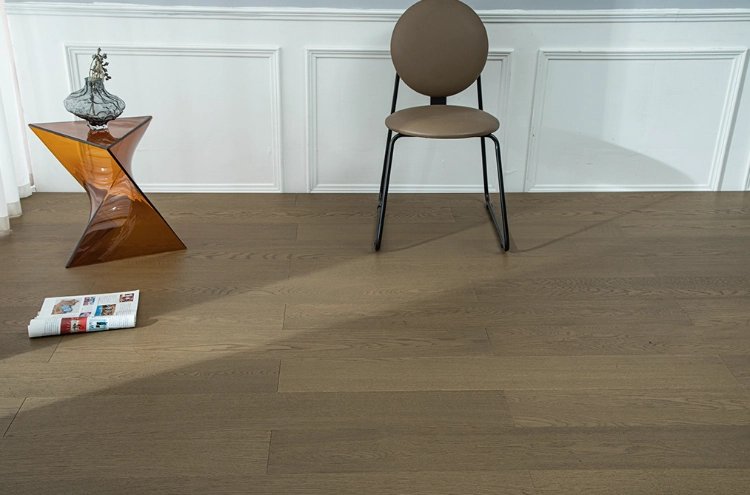
Within YEHUI’s oak Herringbone selection, R1101, R1506, R1106 and R1507 have different colour appearances. The Y211, Y212 and Y215 oak Chevron examples show visible grain variation and darker natural markings. These visible differences provide a reason to request the exact selected product for review. They cannot establish a knot count, identify every dark mark or define a sapwood allowance from a photograph.
Turn preferences into a short acceptance sheet
The useful document is brief enough to travel with the order. Each row should contain an agreed value, a defined visual reference or a clear exclusion. Blank cells remain open decisions.
| Appearance item | What the buyer and supplier should agree |
| Knot size | Measuring method and maximum permitted visible size |
| Knot frequency | Counting unit and treatment of clusters |
| Filled features | Permitted appearance, filler colour and reference sample |
| Edge knots | Whether allowed and any location restrictions |
| Sapwood | Coverage basis and permitted placement on the face |
| Inspection | Sampling approach and action for a board outside the agreement |
Consider a hypothetical approval dispute: a buyer accepts one board with a narrow pale strip, then receives boards with wider pale areas. The approved board proves that one appearance was acceptable. It does not establish a maximum width or coverage allowance. A written limit and a labelled upper-limit sample would make the decision much easier to review.
Approve a range of boards and retain the decision
YEHUI selects materials and screens pieces before packing. Its manufacturing processes include wood cutting, drying, moisture control, fine sanding, sizing, surface treatment and lacquer finishing. Machine checks and manual inspection are both part of its production controls, covering dimensions, thickness, moisture content and stability. Those controls support a product discussion, but a buyer’s particular knot and sapwood limits still need explicit agreement.
One unusually uniform board makes a poor record of a varied order. A more useful review set shows the supplier’s proposed range, with each piece labelled so it can be found again. Photographs taken under comparable lighting help the team discuss individual features. The physical pieces should remain available too; a screen image is an imperfect reference for colour.
Finding a board outside the appearance limits is one decision; deciding what to do with it is another. The order terms should cover any sorting, replacement or other remedy separately, before a disagreement arises.
Send a grade-specific enquiry
يهوي provides product consultation, design, measurement and sampling support. Customization takes account of the customer’s budget, style, dimensions and requirements. Its work with building-material dealers is supported by sales and after-sales teams. The company’s controls extend from raw-material procurement through finished-product inspection.
For a grade-specific enquiry, the purchasing team should send the exact product code, the intended appearance and a draft acceptance sheet. The supplier can then confirm what is feasible for that order. Any revised allowance should be recorded before the order is released.
Two questions to settle before release
Does a cleaner appearance grade prove better performance?
No. An agreement about visible knots and sapwood does not establish coating performance, construction quality or suitability for a particular project. Those need their own product information and evidence.
Can a sample photograph replace a written allowance?
It can illustrate an agreed feature, but it cannot define an unstated counting rule or coverage limit. A usable approval joins the image to the product identity, written criteria and retained sample record.


 Arabic
 English
 Spanish
 French
 German