

The first question on a radiant-heat flooring enquiry is which board is being quoted. ‘Engineered’ only describes a type of construction; it does not approve that board for a heater. You should keep the named floor configuration, the supplier’s written conditions and the heating specification together in the order file. If they do not agree, the technical approval stays open.
For an importer, a colour sample may be enough to choose the look. It says nothing about how that exact board fits the project’s heating assembly. Keep the appearance sign-off apart from the technical one, so a designer’s colour choice cannot be mistaken for permission to release the purchase order.
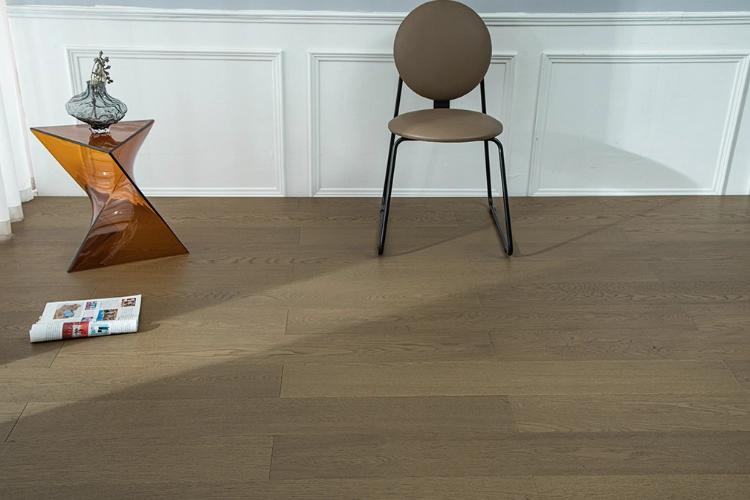
Start with the project heating specification
Identify the system and the responsible documents
Start the enquiry with the heating-system name, its supplier and the current revision of its specification. The words ‘radiant heat’ alone leave too much unanswered. State whether the system uses water or electricity and show the proposed floor build-up, while leaving heating design to the responsible system party.
Name the person who can answer system questions and the person who will review the flooring submittal. Otherwise two neat-looking document sets can sit in the file without anybody checking whether they describe the same assembly. A dated reply tied to the project and floor model is far more useful than a catalogue sentence.
Keep system requirements separate from flooring assumptions
A board that was straight when packed can change as it acclimates to a different room. Wood moisture content follows the surrounding temperature and relative humidity; Chapter 4 of the USDA Wood Handbook explains that material behavior. Give the chapter to a specifier who wants the background, while asking YEHUI for the separate statement about the exact board being ordered.
Put the floor supplier’s environmental conditions and the heater supplier’s requirements on the same review sheet. If the heater runs outside a stated flooring condition, that is an open issue for the named technical reviewers. Ask them to resolve it in writing. A limit copied from a different model would only make the file appear complete.
Match supplier information to the exact flooring product
Check construction and dimensions
At the sample meeting, a colour chip is not enough. Bring a section drawing of the engineered board: its wood face, layered base and, where specified, cross-oriented base layers. The sheet should tie wood species, grade, overall size and thickness, face-layer build and surface treatment to the model number. A buyer can then see whether the quoted item is the one the technical letter discusses.
Put the drawing beside the quotation before asking for heating approval. The signature on one configuration should stay with that configuration unless the change is reviewed.
Start the design search with the مجموعة أرضيات خشبية هندسية if useful, then move to a named model. Ask for that model’s drawings and heating information rather than save the category page as ‘proof.’ The photograph settles a look, not the conditions under a warm floor.
Verify the scope of any heating statement
When a supplier sends a heating letter, you should put its model and revision beside the quotation. Does it include this width, thickness and finish? Are there conditions or excluded uses? If the letter only covers a product family, ask the author to connect the quoted board to it. After a construction change, the old letter should go back for review.
Cutting, drying, moisture-content control, sanding, sizing, surface treatment and lacquer finishing appear in YEHUI’s production workflow. The company also describes machine and manual checks, including thickness, dimensions and moisture content. That helps frame a question about production quality records. It does not give the buyer permission to assume a heater operating temperature or a suitability verdict.
A parquet brief should still say which grade, finish, dimensions and moisture-control expectations apply. Herringbone or Chevron wood flooring describes the intended pattern, but not the build of a board that will sit over heating. Keep the construction with the drawing when the enquiry moves from design to purchase.
Close the documentation gap before procurement release
Ask which written conditions govern the assembly
Send the flooring supplier the named board and ask for its conditions. Send the heater supplier or project specifier the proposed floor build-up. Depending on the project, the replies may need to address thermal resistance, operating restrictions, controls and when a statement stops applying. Let the responsible parties supply those values; a buyer should not estimate them.
Return a letter that says ‘suitable with care’ and ask the author to name the actual conditions. If the answer relies on another document, put its title and revision next to the letter. Any exception should travel with the order; an email in one buyer’s inbox will not help the installer months later.
Record unresolved points and ownership
Picture a quotation for a 190 mm board next to a heating letter for 180 mm. Similar appearance is irrelevant to that mismatch. The supplier needs either to correct the letter or to explain, in writing, why 190 mm is within the stated scope. Until then, the order has no product-specific heating answer.
On the review sheet, each unanswered point gets an owner and a document needed for closure. Price negotiation need not wait. The technical box, however, stays open until the evidence arrives and someone records the decision.
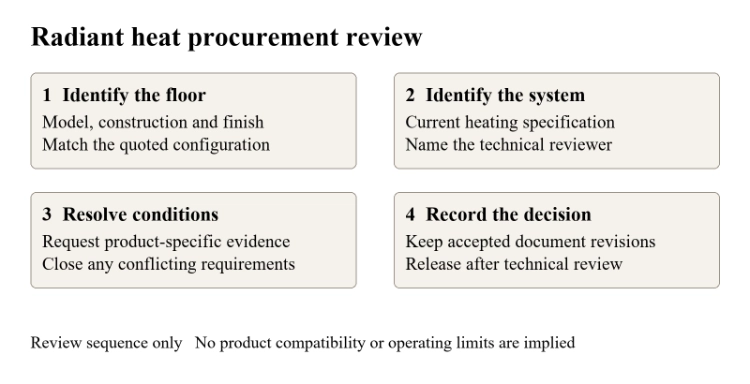
Match the board named in the purchase file to the conditions for the heating assembly before recording a technical sign-off.
Build a project submittal checklist for the order file
A submittal should let the next buyer follow the decision without calling the previous one. Which board was selected? Which heater revision was checked? What did the supplier actually say, and who accepted it? Put those answers in the same file rather than spread across a chain of messages.
| Record | Buyer check |
| Quoted flooring | Model and configuration match the technical sheet |
| Heating specification | System name and current revision are recorded |
| Supplier statement | Covered product and conditions are explicit |
| Open questions | Responsible party and required reply are identified |
| Release record | Accepted revisions and reviewer are recorded |
The commercial file has its own fields: packaging, container loading, minimum order quantity and lead time. Samples or sample books help settle appearance. Request certification, tests or environmental documents that YEHUI actually holds, then check whether each covers the board and order under review.
For a custom parquet brief, record colour, size, grade, surface treatment, borders and pattern combinations. YEHUI offers design and sampling support and customisation around budget, style, dimensions and customer requirements. Settle what is available and what final build is being quoted for this enquiry.
إن custom flooring enquiry service gives a buyer a way to discuss a revised design. Label every change to the board or finish at that point, because the earlier heating response may describe the old version. The sample tag, quotation and purchase order should carry the same revision.
Questions buyers ask about radiant heat and engineered wood flooring
Can every engineered wood flooring product be assumed compatible
No. Engineered construction gives a buyer a board type, not a blanket heating approval. For this order, ask the flooring supplier about this configuration and let the project reviewer compare its conditions with the chosen system. Until the two sides are connected, record the answer as pending.
Which documents should be reviewed before specification
The technical reviewer needs four things in front of them: the selected board sheet, the heater specification, the supplier’s statement for that board and answers to any mismatches. Do not substitute the catalogue, approved colour or agreed price for one of those pieces. They address different decisions.
Send a project-specific specification request to YEHUI
The first request to يهوي can be quite specific: model reference, current heating specification, chosen design and dimensions, quantity and timing. Then ask for the product specific technical information available for that version. This gives the supplier a real assembly to answer about.
Importers still need to settle sample timing, batch consistency, packaging, shipment and after-sales arrangements. Handle those commercial points while the heating review runs, then bring the files together at release. The purchase should identify the floor and accepted conditions, with no unanswered suitability issue left behind.


 Arabic
 English
 Spanish
 French
 German